Sinaloa Security: Mexican Forces Capture 'El Chapo Isidro' Amid Street Violence
The arrest of the Beltrán Leyva leader triggered a nighttime shootout in Guasave, prompting the deployment of special forces to secure the region.
By Emmanuel Mwangi ·
Mexican security forces detained Fausto Isidro Meza Flores, a top leader of the Beltrán Leyva criminal organization, after a chaotic operation in Sinaloa state. Meza Flores, known as "El Chapo Isidro," was one of the FBI's 10 most wanted fugitives and faced charges related to drug trafficking and illegal firearms.
The capture took place in the city of Guasave. Federal officials reported that the operation relied on stealth and surprise. A security perimeter was established around a building where Meza Flores was located. Armed personnel entered the home after coming under attack with guns and explosives from suspected cartel operatives. He was later transported by aircraft to Mexico City to face prosecutors.
The arrest followed a period of intense regional conflict. The Beltrán Leyva organization has been allied with the Los Mayos faction of the Sinaloa cartel. That faction was designated as a foreign terrorist organization by the Trump administration last year. The two groups have been fighting for control of the northern state.
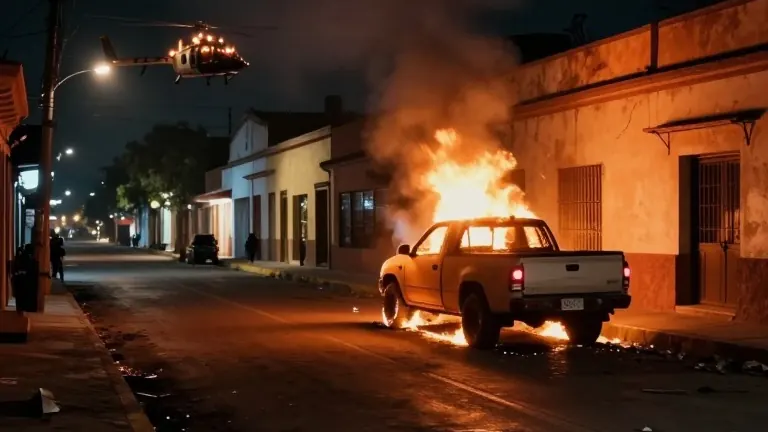
Violence erupted overnight in Guasave following the detention of Meza Flores and his second-in-command. Video footage released by authorities showed screaming civilians fleeing gunfire at a baseball game. Cars and businesses burned on the streets. Helicopters circled the area while firing at people below. The Mexican army and National Guard special forces were unable to extract Meza Flores from the city until 4 a.m. on Saturday.
A federal official who spoke on condition of anonymity described the extraction as extraordinary. The official said cartel members maintained at least 10 roadblocks using burning vehicles to block streets in Guasave. No casualties were reported from the operation itself, though the surrounding chaos affected thousands of residents.
Paola Sánchez, a firefighter and resident of Guasave, told the Associated Press that thousands of people took shelter in grocery stores and other locations late Friday due to intense gunfire. She reported that many businesses, cars, and trucks were burned. Firefighters at the local station waited for orders until Saturday morning before dispatching crews to check for remaining fires. Sánchez stated that the city appeared calm by Saturday morning.
Mexican Security Secretary Omar García Harfuch confirmed on social media that armed forces would remain deployed in Sinaloa to protect civilians. The government stated that intelligence from the Trump administration assisted in the capture, though few details were provided on the coordination between the two countries.
The U.S. Drug Enforcement Administration issued a statement commending Mexican authorities. The agency said the capture delivers a blow to a ruthless organization that traffics fentanyl into American communities. It noted the importance of intelligence sharing in targeting cartel leaders. García Harfuch called the detention an important step in pacifying Sinaloa.
This arrest follows the military killing of Nemesio Oseguera Cervantes, known as "El Mencho," leader of the Jalisco New Generation cartel, in February. President Claudia Sheinbaum has faced pressure from U.S. officials to crack down on criminal groups. Homicides in Mexico have decreased over her two years in office.
Security analyst David Saucedo noted that the governments of Mexico and the United States are increasingly relying on a kingpin strategy. Critics argue this approach often triggers violent power disputes. Saucedo said that while high-profile leaders are arrested, the broader network of hitmen, street-level dealers, and political connections often remains intact.